Artist Mychael Barratt

Lichtenstein's Dog by Mychael Barratt

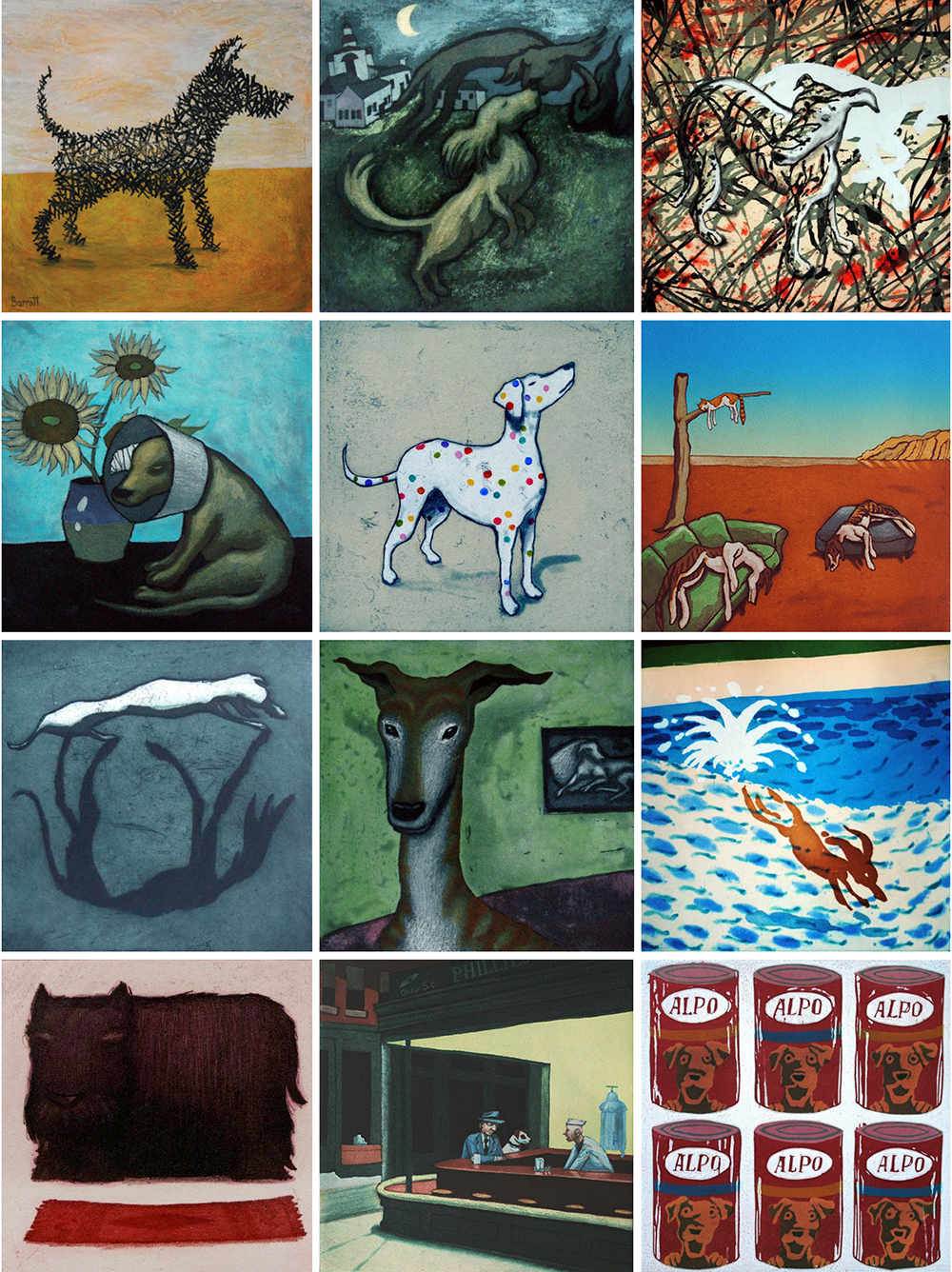
Mychael Barratt is a Canadian-born and now London-based printmaker who has some amazing work. I’m thinking he also has a great sense of humor: check out his series of prints created in the style of famous artists, featuring dogs they might have had. I love them! The Lichtenstein above is my favorite, and below there are some others from the series. See how many you can identify, and I’ll put the names at the end. No peeking!

Artist Series by Mychael Barratt

First row: Gormley, Chagall, Pollock  Second row: Van Gogh, Hirst, Dali  Third row: Giacometti, Modigliani, Hockney  Fourth Row: Rothko, Hopper, Warhol

Another fascinating series by Barratt is his “Life Imitating Art” works. In the one below, he’s melded many different famous works of art featuring dogs into a single composition. It’s kind of a little journey through art history. This time you can take a look and see what you can find on your own, then I’ll put the key which identifies the source material he used. But look closely, there are a total of 12 different works in there!

Life Imitating Art VIII by Mychael Barratt

Life Imitating Art Key

Personally, I’ve always appreciated a good sense of humor and wit (is this a Canadian trait or something? A secret ingredient in Tim Horton’s donuts maybe?), and it’s even better when combined with incredible artistic talent. If you’d like to see more work by the very talented and clever Mr. Mychael Barratt, including other series such as his Shakespeare works, visit his website here. Many of the prints are still available for purchase.

Typographic Tuesday: EB White

EB White Quote

Boy that’s the truth! But I will add that time and nurturing given to any dog will work miracles. Every single one of them deserves that.

Here’s E.B. White and his dog Minnie, a dog he saved from a research facility. Looks like she might have became an editor.

EB White and Minnie

Typographic Tuesday: Elizabeth von Arnim

quote by Elizabeth von Arnim

Now don’t get huffy, she’s got a good point. Here is a bit of an excerpt, including and beginning with the quote above, from Elizabeth von Arnim’s book, All the Dogs of My Life:

“I would like, to begin with, to say that although parents, husbands, children, lovers, and friends are all very well, they are not dogs. In my day and turn having been each of the above,—except that instead of husbands I was wives,—I know what I am talking about, and am well acquainted with the ups and downs, the daily ups and downs, the sometimes hourly ones in the thin-skinned, which seem inevitably to accompany human loves.

Dogs are free from these fluctuations. Once they love, they love steadily, unchangingly, till their last breath.

That is how I like to be loved.

Therefore I will write of dogs.

Up to now I have had fourteen, but they weren’t spread over my life equally, and for years and years at a time I had none. This, when first I began considering my dogs, astonished me; I mean, that for years and years I had none. What was I about, I wondered, to allow myself to be dogless? How was it that there were such long periods during which I wasn’t making some good dog happy?”

Elizabeth von Arnim and her dogs

Great picture, and sounds like a pretty good book to me! If you agree, here is a link to it on Amazon.

Dognition & The Genius of Dogs

Dognition Badges

I’m lucky enough to live near some of the best universities in America where interesting studies and programs of all kinds are always going on. There’s one program in particular often featured in the local media that always gets my attention: Duke University’s Canine Cognition Center, which is often looking for people to bring their dogs in for evaluation. Dr. Brian Hare is the director of the program and he has recently published a book titled The Genius of Dogs, so there is now a lot of national and international interest. Personally, I think that if you’re a dog person, once you hear about some of the findings, you’re going to say “Of course, I’ve always known that!” But what I think is really important is that now there’s scientific data to support what dog folks have known all along: dogs are much smarter than most people think. And because of this, maybe people who didn’t give dogs much of a chance before will realize what they’ve been missing out on. Take that, cats!

Dr. Brian Hare

Basically Dr. Hare has found that unlike any other species (besides us), dogs are able to infer meaning from unspoken communication. It’s true: they watch us, observe us and understand gestures…even when we don’t realize it. Dogs that I’ve had over the years have learned to monitor my intonation when I’m on the phone during long conversations (mother), realizing that when it rises that’s a signal that I’m getting ready to (finally) hang up, which means they’ll get my attention back. Another example from my house would be when Chappie connected that when I groan it means I’m picking up a ball to throw for him, so if he hears me groan any other time he goes long. I didn’t actually realize that I was groaning during playtime after a long session in front of a computer. Thanks for pointing that out, Chappie. Sheesh.

Besides the book, Dr. Hare has been working to develop a website and mobile app with the talented McKinney Advertising agency called Dognition that anyone can use (and he’s hoping everyone will because it’ll help his research studies) to help develop your own dog’s personality profile with details on his cognitive strengths and weaknesses. You can check out the dognition site here. And a good newspaper article about it can be found here.

If you’d like to learn more about the Duke Canine Cognition Center, go here. They are offering summer internships (with a stipend!) if you’re interested, but you’d better make it snappy because application submissions close March 15.

Last but not least, I’d just like to say that I think Dr. Hare must be a cool guy, because how many other Harvard PhD’s feature their portraits rolling around in the grass with their dog and describe themselves as “scientist, author, dog guy”? His own personal site is here. If you’d like to listen to a great interview with Dr. Hare, the local National Public Radio station WUNC broadcast is here.

So dogs can even make science better—now I wonder what they can do for algebra.


The Portraitsphere: Claire Dunaway

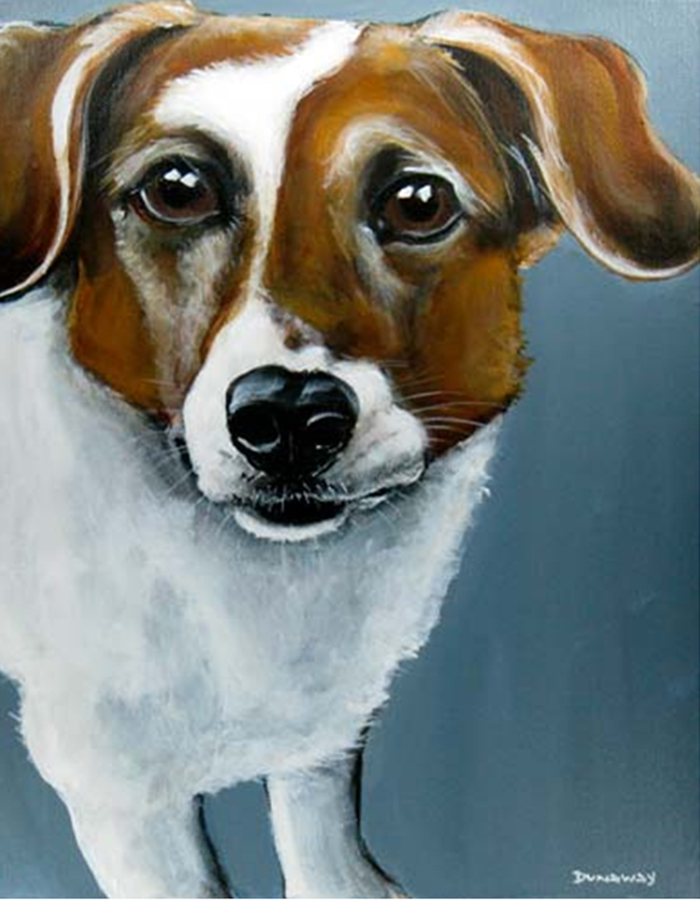
Dog portrait by Claire Dunaway

Here we go into the Portraitsphere: the world of Marietta, Georgia-based artist and teacher Claire Dunaway. And on this journey, you might not leave empty-handed: Bark Magazine is hosting a contest and you could win a portrait of your very own.

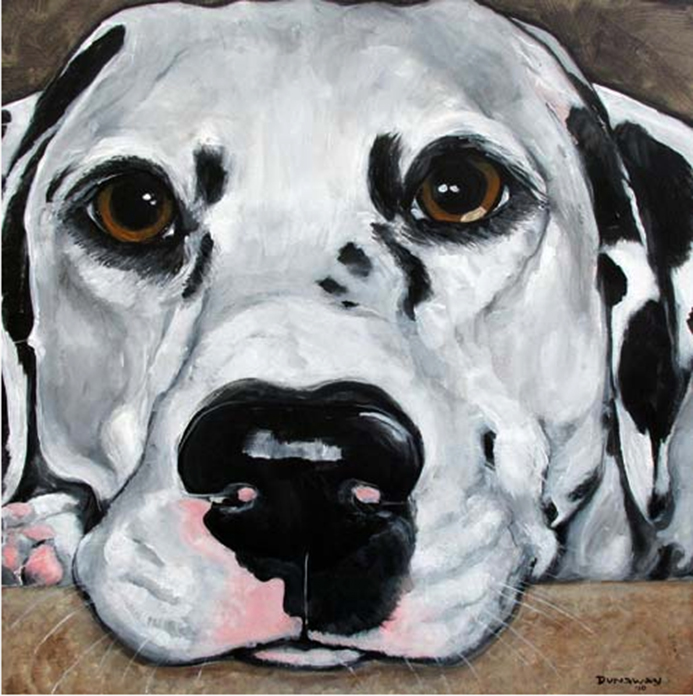
Dog Portrait by Claire Dunaway

Claire describes her inspiration this way:

“I am an artist and a teacher who embraces learning and exploring. As a native Georgian born and raised, I am deeply influenced by my family, faith, canine camaraderie, history and love for country; those numerous and powerful influences in my life can be seen running through the pieces I create.”

I especially like her appreciation of an easily-distracted mind (because I have one myself):

“I give thanks to God for giving me the eyes to see, the easily-distracted mind to notice and the heart to create.”

And create she does. Just look at all these faces!

Claire Dunaway's dog portraits

If you’d like to check out more of Claire’s work, you can visit her website here. And if you’d like to enter Bark Magazine’s contest and win a 16 x 20 portrait of your dog, do so before May 14, 2013 by visiting their site here (sorry, the contest is only open to US residents). Good luck!

Typographic Tuesday: Best Friends

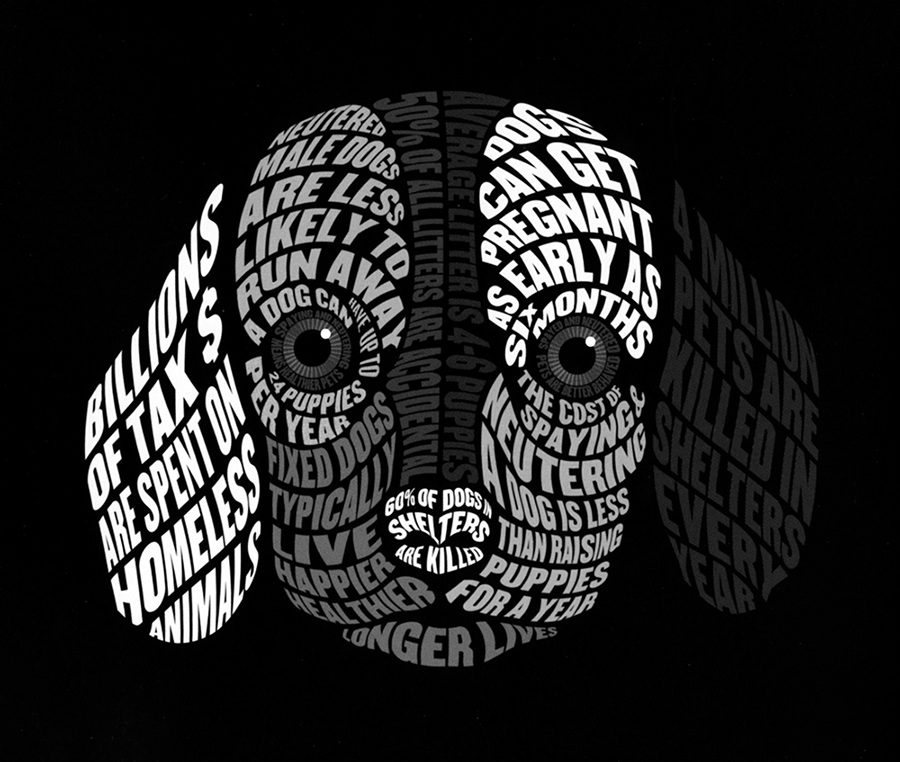
Best Friends Animal Society Ad

It’s Typographic Tuesday, and today I’m featuring a message from Best Friends Animal Society. They’ve cleverly packed some good facts into this puppy head about pet overpopulation here in the US, and the importance of spaying and neutering. Not only did they do a great job with this project, they always seem to hit the mark with their communication efforts. Ah, the power of good design.

It’s World Spay Day

Doris Day and Doggie

You tell ’em, Doris!

Doris Day, that is. And she’s featured here because she, along with her Doris Day Animal Foundation, founded World Spay Day—and that’s today, folks! Always the last Tuesday in February, this day is meant to draw attention to pet overpopulation and encourage spaying worldwide. It comes at the end of February (and I’m wondering if it shouldn’t be held at the beginning instead) because all month long it’s been Spay/Neuter Awareness Month. All over the world there have been great free or low cost clinics available to get as many pets spayed as possible, and you’ve gotta love these names: Spay It Forward, Hunka Hunka Furry Love, Neuter Your Scooter… um, you get the idea. So if you know about a certain furry being that needs to be “tended to”, check out what’s going on in your area before the end of the month—or get the word out to others—and save some money at the same time.

Here are a few more photos of dear Doris, because well darn it, they just don’t make celebrities like they used to!

Doris Day with black doggie

Doris Day with dogs

You can find more information about World Spay Day, locate a spay event in your area, or enter the spay pageant on the official portal here. Various groups and clinics around the world have been uploading photos from different spay events, mobile services, etc. and it’s really great to see the reach.

Information on the Doris Day Animal Foundation here.

Typographic Tuesday: Do What You Love

Do What You Love print by ConiLab

It’s Typographic Tuesday, and at first today’s quote isn’t exactly about dogs, but for me it is! Because dogs are what I love, and design of course, and putting them together is my dream job. So I’m having a coffee toast to my company Pantofola and savoring this longer version of the above by Steve Jobs:

“Your work is going to fill a large part of your life, and the only way to be truly satisfied is to do what you believe is great work. And the only way to do great work is to love what you do. If you haven’t found it yet, keep looking. Don’t settle. As with all matters of the heart, you’ll know when you find it. And, like any great relationship, it just gets better and better as the years roll on. So keep looking until you find it. Don’t settle.” — Steve Jobs

Thanks to my friend Mark McNeilly (who also has a couple of great dogs!) for sharing this Steve Jobs quote, the timing was perfect.

Last but definitely not least, the image above is a beautiful screen print by Spanish artist Coni Della Vedova that I purchased from her Etsy shop a few years ago. It’s a nice size, an A3 (11.7″ x 16.5″) and is printed on lovely paper, and she ships anywhere. You can still get one here!

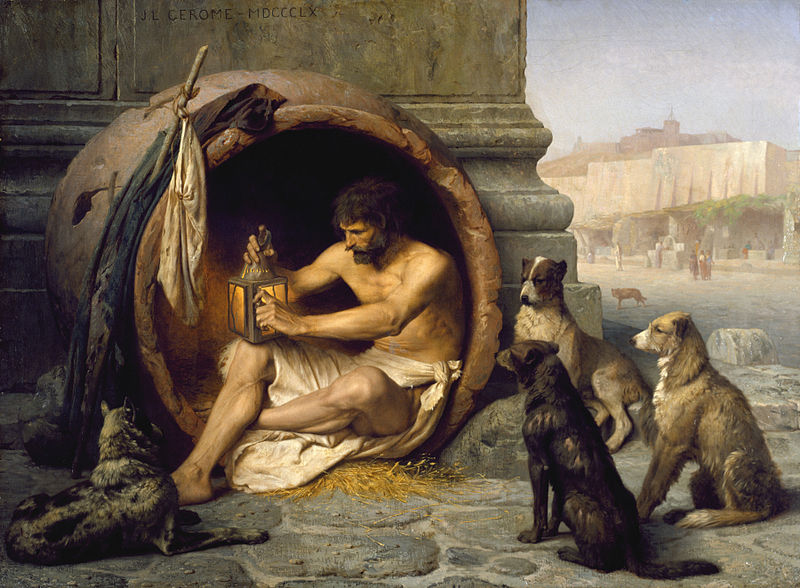
Diogenes “The Dog”

Painting of Diogenes in his jar with dogs by Jean-Léon Gérôme

I don’t know about you, but I find it to be so incredibly fascinating how dogs are woven into human history. It seems that at every turn, there’s something about a dog’s role in our evolution. And I’m not just talking about a caveman with a dog for protection and survival, but the ways that they’ve helped to shape our thinking and philosophy…

Diogenes of Sinope was a Greek philosopher and one of the founders of Cynic philosophy. A rebel, he turned his back on his banker father and chose to separate himself from regular society by living in a jar in the middle of town and hanging out with dogs. He was the kind of guy you’d meet and probably think to yourself “What a jerk!” and then realize, well, he’s got a good point. He was known for stunts like carrying a lamp around in the daytime, claiming to be looking for an honest man. When he met Alexander the Great, who was thrilled to meet the famous philosopher, and was asked if there was anything he could do for him, Diogenes replied “Yes, stand out of my sunlight.” Nice. After that, Alexander declared “If I were not Alexander, then I should wish to be Diogenes”, to which Diogenes replied “If I were not Diogenes, I should also wish to be Diogenes.” Well, okay then!

Alexander the Great meeting Diogenes

Now hold on, before we go any further, just because Diogenes was a Cynic, don’t start thinking of him as the original “Debbie Downer”. Like a lot of things, the meaning of the word “cynic” has evolved to be something negative in our modern world. According to The Internet Encyclopedia of Philosophy, “classical Cynics regarded virtue as the only necessity for happiness. They sought to free themselves from conventions; become self-sufficient; and live only in accordance with nature. They rejected any conventional notions of happiness involving money, power, or fame, in the pursuit of virtuous, and thus happy, lives. In rejecting conventional social values, they would criticise the types of behaviours, such as greed, which they viewed as causing suffering.” And there were other things they stood for, like cosmopolitanism, freedom of speech, a woman’s right to choose her mate, constitutional law, and—as the name indicates—emulating the simple behaviors of dogs. By the 19th century, however, emphasis shifted to the negative aspects of the philosophy, leading to the modern understanding of cynicism to mean “a disposition of disbelief in the sincerity or goodness of human motives and actions.” Boo.

And what is the connection with dogs? Well, the term “cynic” derives from the Greek word kynikos which means “dog-like”. From Wikipedia: “Diogenes believed human beings live artificially and hypocritically and would do well to study the dog. Besides performing natural bodily functions in public with ease, a dog will eat anything, and make no fuss about where to sleep. Dogs live in the present without anxiety, and have no use for the pretensions of abstract philosophy. In addition to these virtues, dogs are thought to know instinctively who is friend and who is foe. Unlike human beings who either dupe others or are duped, dogs will give an honest bark at the truth.”

So it appears that even way back then, dogs were recognized by some important thinkers as role models for how society should be, and I’m down with that. Well, except for the public display of a few bodily functions. Shine on, Diogenes.
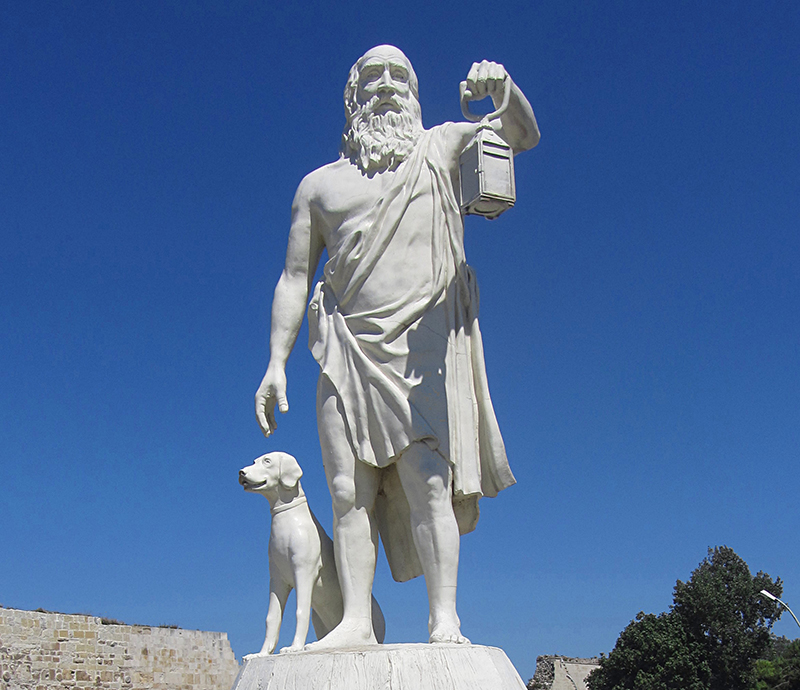
Diogenes statue, with lantern and dog

I realize this was a brisk breeze through the topic of Diogenes and Cynicism, but you can read more here if you are interested. Thanks to Wikipedia for the information and images. 

Images from top: Diogenes, Jean-Léon Gérôme, 1860; Alexander and Diogenes, Caspar de Crayer, c. 1650; statue of Diogenes at Sinop, Turkey.

And Maverick Was His Name-o

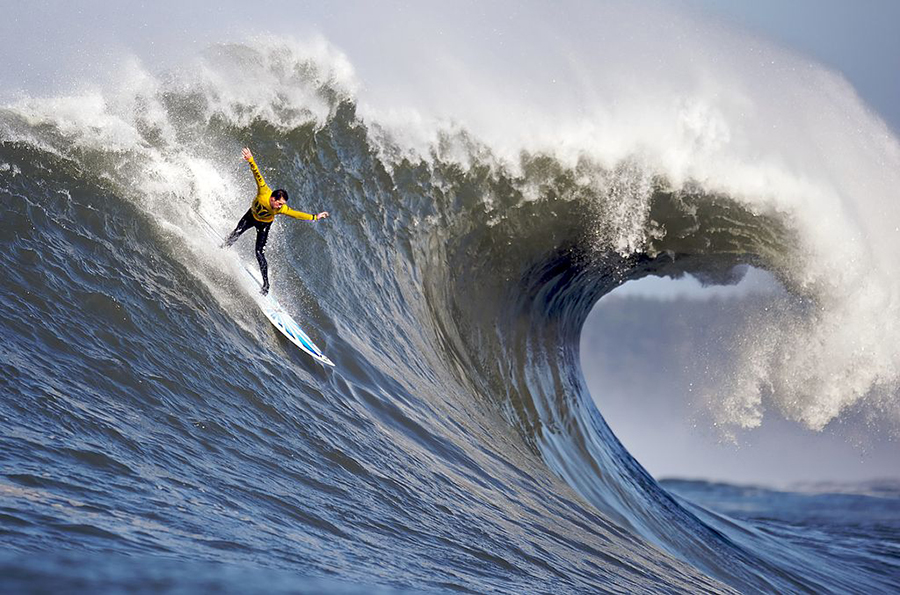
2010 Mavericks Competition

Maverick’s is a famous big wave surf spot in northern California, just a few miles from Half Moon Bay. Since waves can break at about 80 feet high, it’s also the location for a world-renowned big wave competition held each winter, as long as there’s a good winter storm to produce these maximum waves. Only the world’s top surfers are invited, and there is just a 24-hour notice given to these select 24 individuals to grab their boards and hustle there to compete.

But the neatest part about Maverick’s (as far as I’m concerned) is how it got its name. According to Bark Magazine‘s spring 2013 issue:

“In early March 1961, three surfers decided to explore the big waves breaking about a half-mile from shore at Pillar Point, near Half Moon Bay, California. A friend’s white German Shepherd, Maverick, came to the beach with them. Maverick was used to swimming with his surfing buddies, and paddled out after them. Concerned for the dog’s safety, one of the surfers returned him to shore and tied him to the car bumper. Ultimately, the immense waves proved to be too much for them as well, and the men cut their day short. Because the dog seemed to have had the most fun that afternoon, they named the giant waves in his honor. Today, the Mavericks Invitational is known worldwide as a testing ground for elite big wave riders.”

Cool, man.

Maverick's 2013

Visit the Mavericks official contest website here. Photo above courtesy of The Inquisitr, read about this year’s contest winner 43-year-old Peter Mel’s victory along with a video on their site here. Great SF Chronicle article on a Maverick’s film here.
Thanks to Bark Magazine for the heads up on this story. Best dog magazine ever.